Rule of Law, Peace, Stability, Viable State
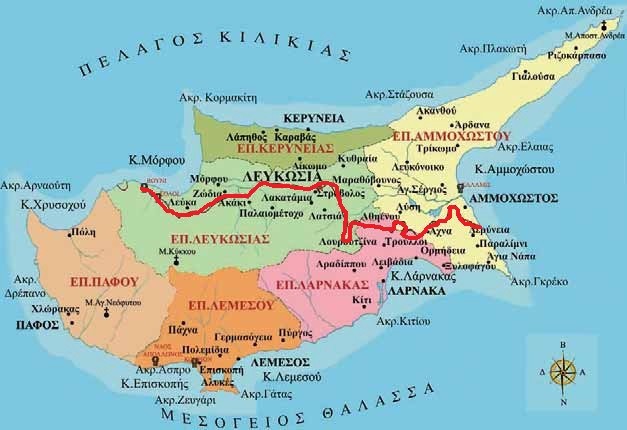
At issue is international and European legal order. An outcome of every new round of negotiations should be the termination of the illegal de facto state of affairs created by the illegal invasion of Turkey in July 1974. Only the termination of the illegal de facto state of affairs could lead to peace, stability and security for all states involved. The attached articles underline certain critical matters related to a peaceful resolution of the “Cyprus issue”. Such a resolution will promote regional peace and stability for all states concerned. Moreover, it will strengthen the international and EU legal system, the rule of law and exemplify the peaceful resolution of conflicts.
The first article, available here in four languages, English, Greek, French and German), is an important text entitled: «A principled basis for a just and lasting Cyprus settlement in the light of International and European Law». It was written by the “International Expert Panel” convened by the “Committee for a European Solution in Cyprus” of which I had the honor to be a constituent member. This report advocates the application of international and European rule of law as the only realistic approach whose implementation will guarantee a viable future for the Republic of Cyprus and all its citizens. For those UN representatives and EU officials currently involved in the search for a solution this report is invaluable and precious: It outlines the prerequisites for a peaceful and viable “solution”. I need not emphasize here that the Republic of Cyprus is currently a member of the United Nation, of the EU and of the Counsil of Europe, three of the foremost global institutions. Just to note that a member of the “International Expert Panel” was Alfred de Zayas. He wrote a valuable article entitled, “The Anan plan and the implication of Turkish settlers in Northern Cyprus” https://wp.me/P3OqMa-MM.
Τhe second attached article is a recent English language one that I have published in Volume 11, 2024-5 of the Society of International Relations and International Law. It is entitled: «Republic of Cyprus: International and European Rule of Law as a Cornerstone of Peace, Stability and a Viable State». This article is also posted in my webpage-link https://wp.me/p3OqMa-3u9. In this article, inter alia, I emphasize the critical fact that the Republic of Cyprus is a member-state of the EU, that international legal order defined by the Treaties is the most important criterion in interstate relations and that the role of the UN and more specifically the role of the Security Council, in both legal and political terms, is to re-establish the existing international legal order when this order is violated. Moreover, my article describes its jurisdiction as regards the legal order as defined by International Treaties. It also refers to crucial provisions of the Charter of the UN and the very important Security Council Resolutions related to Cyprus of 1974,1975 and 1983. These resolutions concern the two illegal Turkish military invasions of Cyprus in July and August 1974 and call for the cessation of the Turkish occupation of part of Cyprus which the Security Council characterized as “legally invalid”. Currently, the areas of the Republic of Cyprus under occupation of a NATO member, Turkey —and an aspiring EU candidate state— amount to 37% of the territory and 57% of its cost-line. The aforementioned resolutions of the SC, moreover, explicitly clarify that the illegal de facto state of Affairs caused by the illegal invasion of 1974 must not prejudge the outcome of the negotiations.
Concerning these Security Council resolutions it is necessary to emphasize that they are the only ones which are compatible to the UN Charter in which it is clearly stated that: «Nothing contained in the present Charter shall authorize the United Nations to intervene in matters which are essentially within the domestic jurisdiction of any state or shall require the Members to submit such matters to settlement under the present Charter». As regards the application of measures by the UN, the aforementioned Resolutions of 1974,1975 and 1983 of the Security Council make it absolutely clear who violates international order and who continues to threaten international peace and security: It is not the victim, that is, the Republic of Cyprus, but the state that invaded and created de facto illegal consequences. Nonetheless, after the 1990s, many clauses of subsequent resolutions of the Security Council as regards Cyprus are not valid (and in fact are illegal), because the Security Council, the UN and its representatives, as also emphasized, have no jurisdiction to define the internal regime of the member states. Their only jurisdiction is to re-establish international law and order as clearly and expressly stated in the resolutions of the Security Council of 1974, 1975 and 1983. Given the failure of the Security Counsil to re-establish international order, subsequent resolutions after 1990 addressing Cyprus are not valid (and, I repeat, in fact are illegal) because the UN, the SC and their representatives have no jurisdiction to define the internal regime of a sovereign member-state (essentially by mentioning the consecutive «concessions» of the victim of the illegal de facto consequences). Their only jurisdiction is to re-establish international law and order as clearly and expressly stated in the resolutions of the Security Council of 1974, 1975 and 1983. Last but not least, during the referendum of 2004 the society of Cyprus rejected the plan which proposed the acceptance of the illegal consequences of the illegal invasion of 1974.
If and when the SC of the UN or its representatives propose recognition of the de facto results of the two illegal invasions of 1974: A) They run against the High Principles of the UN and its Charter (Chapter I Article 2 paragraph 7) and even more importantly, B) they do not lead to a peaceful resolution, worse, they establish conditions of conflict and instability. By contrast, a peaceful resolution in Cyprus, in accordance with international and European rule of law will be in the best interest of all states involved and certainly also of Turkey: Realistically and rationally speaking revisionism, illegality, instability and war do not serve the interest of any state. History has proven it repeatedly.
Panayiotis Ifestos
17/07/2026
NB
This letter when posted the two articles mentioned above are attached. The articles are also available in the following addresses: the first «A principled basis for a just and lasting Cyprus settlement in the light of International and European Law» / also https://piotita.gr/2016/10/26/%ce%ba%cf%85%cf%80%cf%81%ce%b9%ce%b1%ce%ba%ce%b7-%ce%b4%ce%b7%ce%bc%ce%bf%ce%ba%cf%81%ce%b1%cf%84%ce%b9%ce%b1-%cf%80%ce%bb%ce%b1%ce%af%cf%83%ce%b9%ce%bf-%ce%b1%cf%81%cf%87%cf%8e%ce%bd-%ce%b3/ and the second https://wp.me/p3OqMa-3u9
P. Ifestos ifestosedu@gmail.com
www.ifestos.edu.gr – www.ifestosedu.gr CV http://wp.me/P3OqMa-10x
Twitter https://twitter.com/ifestosedu
Linkedin https://www.linkedin.com/in/panayiotis-ifestos-0b9382131/
Instagram https://www.instagram.com/p.ifestos/
Strategic Analysis https://www.facebook.com/groups/StrategyStateTheory/
Thucydides and International relations https://www.facebook.com/groups/thucydides.politikos.stoxasmos/
Profile https://www.facebook.com/panayiotis.ifestos
Personal page https://www.facebook.com/p.ifestos




Κατηγορίες:Cyprus Republic, illegal invasion of 1974, International and European rule of law, peace and stability, Security Counsil, United Nations

